

Shimadzu Application News
No: 01-00983-EN
February 2026
HyperVision HPV-X3 Ultra High-Speed Video Camera
Observation of Shock Waves Using the Schlieren Method with the Shimadzu HyperVision HPV-X3
by Yuki Nishikawa
User Benefits:
- The Shimadzu HyperVision HPV -X3 offers three times the resolution of conventional models, enabling high-speed imaging at much higher resolutions.
- With a maximum frame rate of 20 Mfps, the HPV-X3 is well-suited for observing high-speed phenomena such as shock waves.
Equipment:
- Shimadzu HyperVision HPV-X3 ultra high-speed video camera
- Nikon 180mm macro lens with 2x teleconverter
- PAI .50 Caliber Single-Stage Gas Gun & Experiment Tank
- Oxford Lasers FireFLY 500W Short-Pulsed Laser
Location: The Vault @ Hadland Imaging, R&D Training Center, Santa Cruz, California
Introduction
Shock waves are characterized by abrupt changes in pressure and density and are generated when an object travels faster than the speed of sound or during explosive phenomena. They are important research subjects in fields such as aerospace and fluid dynamics. In particular, accurately characterizing the structure and temporal evolution of shock waves generated around projectiles is a crucial issue directly related to vehicle design, behavior prediction, and safety evaluation. Optical techniques capable of detecting minute changes in refractive index are effective for visualizing such phenomena. Among these, the Schlieren method is widely used to visualize density variations in fluids.1 In this paper, the HPV-X3 high-speed video camera (Fig. 1), which provides three times the resolution of conventional models, was used to observe shock waves generated by a pellet launched from a gas gun using the Schlieren method.

Fig. 1 Shimadzu HyperVision HPV-X3 Ultra High-Speed Video Camera

Fig. 2 Projectile
| Table 1 Imaging Devices | |
| High-Speed Video Camera: | Shimadzu HyperVision HPV-X3 |
| Lens: | 180mm macro lens with 2x teleconverter |
| Light: | Laser illumination |
| Table 2 Imaging Conditions | ||
| Recording Speed | Objects Placed in Projectile Path | |
| Imaging (1): | 1,150 ns | Two Rubber Bands |
| Imaging (2): | 1,150 ns | Obstacle with Ten Circular Holes |
Imaging System
The pellet shown at the center of Fig. 2 was placed in the firing chamber of the gas gun, sandwiched between two plastic holders. The holders were used to position the pellet in the firing chamber; after firing, the holders fell away, allowing only the pellet to be captured by the camera.
The imaging system is detailed in Table 1, the imaging conditions are shown in Table 2, and the experimental setup is shown in Fig. 3. Light from the laser source was reflected by concave mirror (1) and collimated between concave mirrors (1) and (2). The HPV-X3 captured images of shock waves generated along the projectile path through a mirror and a knife edge.
The experiment was conducted twice: in the first trial, two rubber bands were placed in the projectile path; in the second trial, an obstacle with ten circular holes (Fig. 4) was placed in the path. This allowed us to observe phenomena such as fragmentation and shock wave reflection.

Fig. 3 Experimental Setup (left) and Fig. 4 View of Pellet Path (right)
Imaging Results
The results of the Imaging (1) are shown in Fig. 5. In image (1), the flying pellet and a shock wave in front of it can be observed. The shock wave ahead is then reflected by the rubber band in image (2), splitting into a transmitted shock wave and a reflected shock wave. In image (3), the pellet collides with the rubber band, and shock waves are generated both ahead of and behind the collision point. At the second rubber band, no clear reflection of the shock wave was observed, possibly because the pellet’s speed had decreased.
Next, Fig. 6 shows the imaging results when the obstacle shown in Fig. 4 was placed in the path. In Image (1), the pellet is positioned immediately before the obstacle. In Image (2), shock waves generation can be observed. In Image (3), the pellet collides with the obstacle, fragments into small pieces, and multiple fragments become visible. It was also confirmed that shock waves were generated from each fragment.
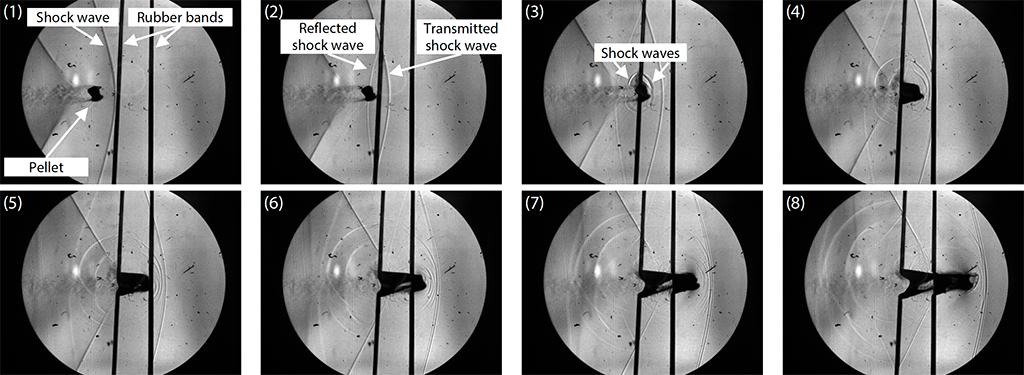
Fig.5 Observation Images of Pellet Passing through Rubber Band (Time Interval Between Images: ~15 μs)
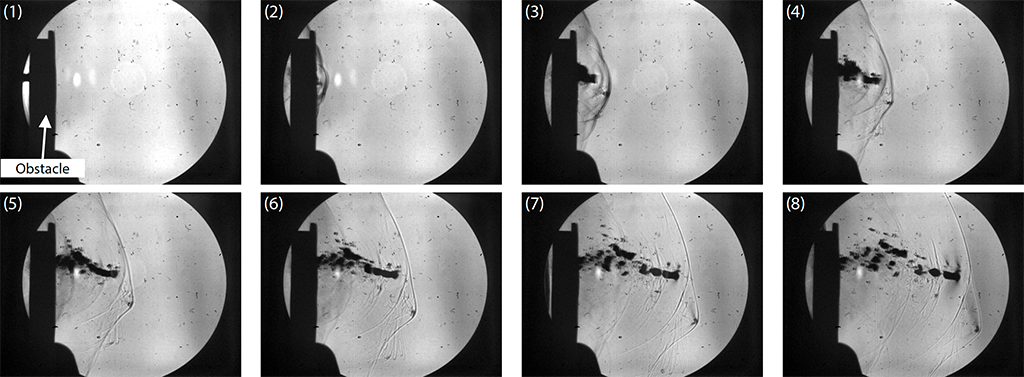
Fig. 6 Observation Images of Pellet Impacting and Passing through Obstacle (Time Interval Between Images: ~23 μs)
Conclusion
Using the HPV-X3 high-speed video camera, shock waves generated by pellets fired from a gas gun were observed using the Schlieren method. This approach enabled close observation of phenomena, including shock waves generated as the pellet passed through or was reflected by rubber bands placed in the projectile path, as well as pellet fragmentation by impact with an obstacle and the subsequent generation of shock waves from each fragment.
The HPV-X3 high-speed video camera has three times the resolution of the previous, HPV-X2, model and is well-suited for detailed observation of high-speed phenomena such as shock waves.
1.) K. Ohtani, “High Speed Visualization Measurement of Underwater Shock Wave and Cavitation Bubble Generation,” 17-22, 2023.


Learn more about ultra high-speed visible, infrared, schlieren & Flash x-ray imaging solutions:
Contact a Hadland Imaging representative to learn more about the Shimadzu HyperVision HPV-X3 & The Vault @ Hadland Imaging, R&D Training Center in Santa Cruz, CA. Better Gear. Better Results. We’ve got the gear & knowledge you need to get the job done right!
Keywords: 20 million fps, PAI .50 Caliber Single-Stage Gas Gun, Oxford Lasers FireFLY 500W short-pulsed laser illumination, Schlieren method, Shimadzu Application News No: 01-00983-EN, Shimadzu HyperVision HPV-X2 ultra high-speed video camera, Shimadzu HyperVision HPV-X3 ultra high-speed video camera, shock waves, The Vault at Hadland Imaging, ultra high-speed imaging