
Shimadzu Application News
No: 01-01052-EN
January 2026
HyperVision HPV-X3 Ultra High-Speed Video Camera
AUTOGRAPH AGX-V2 Series Precision Universal Testing Machine
3D-DIC Analysis in Compression Test of Glass Tube
by Fumiaki Yano & Yuki Nishikawa
User Benefits:
- The Shimadzu HyperVision HPV -X3 ultra high-speed video camera has resolution three times higher than the conventional device, resulting in improved analysis performance in DIC analyses.
- The HPV-X3 high-speed video camera allows recording at a maximum framerate of 20Mfps, two times faster than the conventional device.
- Three-dimensional displacement measurement is possible by synchronous recording using two HPV-X3 high-speed video cameras and 3D-DIC analysis.
Equipment:
- Shimadzu HyperVision HPV-X3 ultra high-speed video camera, 2x
- 100mm macro lens, 2x
- Shimadzu AGX-V2 Series Precision Universal Tester
- REVOX SLG-600V Ultra High Power Fiber Light Source
- Correlated Solutions VIC-3D DIC Analysis Software
Introduction
Glass is used in various industries, such as electronic devices and automobiles. Depending on the intended application, mechanical properties are measured by material testing, but to achieve further improvements in performance, it is necessary to observe the origin of fracture and the condition of crack propagation. However, glass displays brittle fracture behavior, which is difficult to observe visually. In our previous reports, we observed the fracture behavior of glass specimens in ring-on-ring tests1, 2 and those observation results indicated that a high-speed video camera with a recording speed (framerate) of several Mfps or higher is required to observe the fracture behavior of glass. In this experiment, the fracture behavior of a glass tube during a compression test was observed with an HPV-X3 high-speed video camera. In addition, synchronous videorecording was carried out using two HPV-X3 cameras, and the strain distribution during fracture was visualized by a 3D-DIC (three-dimensional digital correlation) analysis.
Specimen Information and Measurement System
The glass tube used as the specimen was compressed in the axial direction using an AGX-V2 precision universal testing machine. Table 1 and Table 2 show the equipment configuration and the specimen dimensions, respectively. In this article, fracture observation in the compression test and visualization of the strain distribution by 3D-DIC analysis were carried out. Fig. 1 shows the condition of the test for the 3D-DIC analysis. When an observation target such as a glass tube has a curved shape, a 3- dimensional strain analysis is necessary. Therefore, synchronous recording from two directions was conducted using two HPV-X3 high-speed video cameras, with a random pattern drawn on the specimen surface, as shown in Fig. 2. Table 3 shows the recording conditions.
| Table 1 Equipment Configuration | |
| High-Speed Video Camera: | Shimadzu HyperVision HPV-X3, 2x |
| Lens: | 100mm macro lens, 2x |
| Illumination: | REVOX SLG-600V Ultra High Power Fiber Light Source |
| Testing Machine: | Shimadzu AGX-V2 Series Precision Universal Tester |
| Load Cell: | 100 kN |
| Test Jig: | Compression Plates (φ50) |
| DIC Analysis Software: | VIC-3D |
| Table 2 Specimen Dimensions | |
| Outer Diameter: | 20 mm |
| Inner Diameter: | 18 mm |
| Height: | 40 mm |
| Table 3 Recording Conditions | |
| Recording Target: | Recording 1 Fracture Observation Recording 2 3D-DIC Analysis |
| Recording Speed: | 5 Mfps |
| Recording Trigger: | Acceleration Sensor |
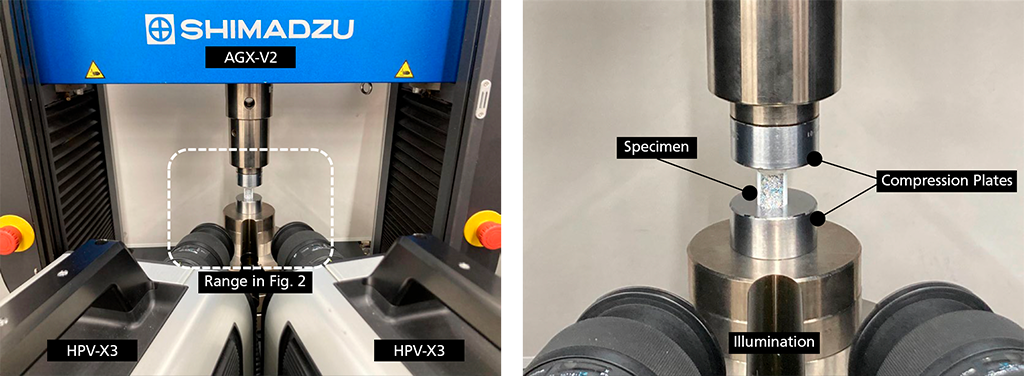
Fig. 1 Condition of Test for 3D-DIC Analysis (left) and Fig. 2 Test Jig and Specimen (right)
Recording Results
Fig. 3 shows the recording results of fracture observation in the compression test of the glass tube. In image (1) in Fig. 3, an axial crack has already initiated, and in image (2), a new crack different from the one in image (1) has also occurred. In images (3) to (5), axial propagation of the crack in image (2) was observed. Subsequently, in images (6) to (8), a similar crack propagated around the circumference of the glass tube, and in images (9) to (12), the condition when the tube shatters into pieces was observed.
Fig. 4 shows the results of the 3D-DIC analysis. From image (1) in Fig. 4, the origin of fracture is on left rear side, and the crack propagates around the circumference in images (2) to (9). Compressive strain concentrates in the unfractured area in front of the crack, as shown in purple. Since the crack propagates around the circumference, the purple area gradually moves to the right. On the other hand, because compressive strain cannot be maintained after crack propagation, strain decreases, as shown in red, and with crack propagation, the decrease in strain also spreads to the upper right.
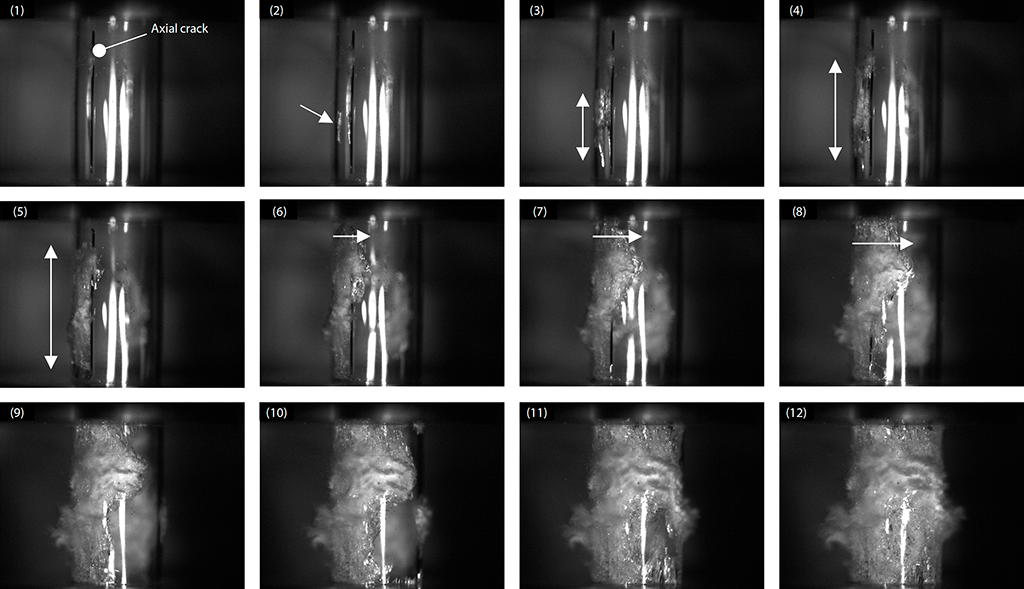
Fig. 3 Condition of Fracture Observation (Time Interval Between Images: 2 μs)
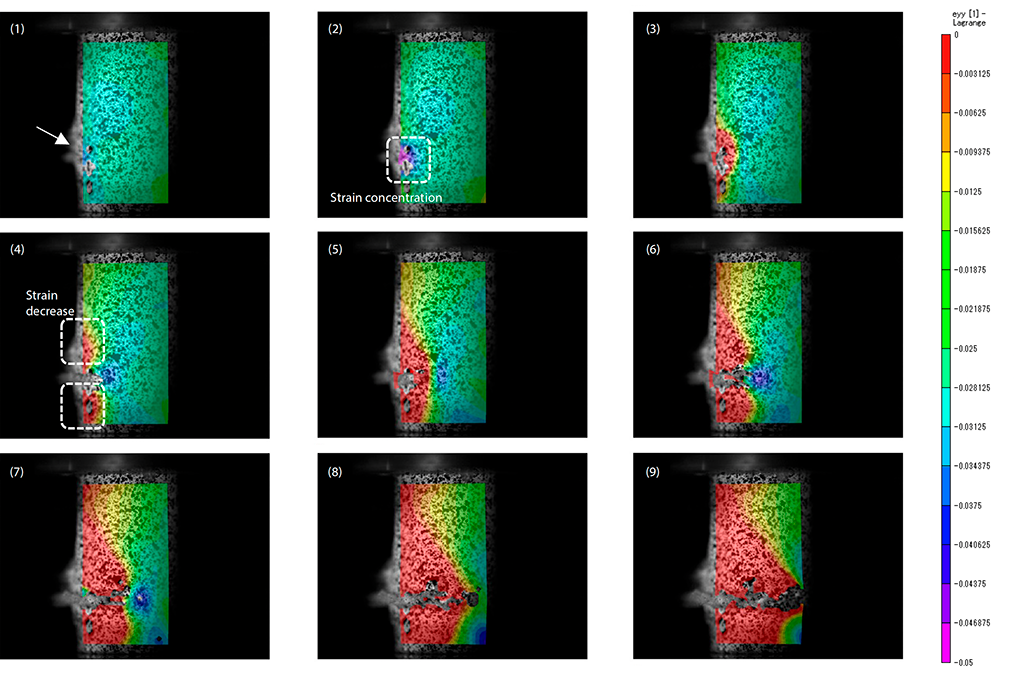
Fig. 4 Condition of Fracture Observation (Time Interval Between Images: 400 ns)
Conclusion
The fracture of a glass tube during a compression test was observed using two HPV-X3 high-speed video cameras, and a 3D-DIC analysis was carried out. In fracture observation, the crack that became the origin of fracture could be identified, and the condition of crack propagation was clearly captured. In the 3D-DIC analysis, it was possible to observe the concentration of strain in front of the crack and the decrease in strain after crack propagation. Since glass fracture is brittle and is extremely rapid, a high-speed video camera with a recording speed of 5Mfps or higher, such as the HPV-X3, is an effective instrument for fracture observation.
Related Application News Articles
1. Fracture Observation of Glass in Ring-on-Ring Bending Test, Application News No. V30
2. Fracture Observation in Glass Ring-on-Ring Bending Tests Using HPV-X3, Application News No. 01-00881
The authors wish to thank Energy Cycle Systems Research, K.Sato Lab., Institute of Advanced Materials Strength, Graduate School of Engineering, Tohoku University for his generous cooperation in the recording.

Learn more about ultra high-speed visible, infrared, schlieren & Flash x-ray imaging solutions:
Contact a Hadland Imaging representative to learn more about the Shimadzu HyperVision HPV-X3. Better Gear. Better Results. We’ve got the gear & knowledge you need to get the job done right!
Keywords: 20 million fps, 3D-DIC analysis, AGX-V2 Series Precision Universal Tester, crack propagation, digital image correlation, glass ring-on-ring-bending test, materials testing, REVOX SLG-600V Ultra High Power Fiber Light Source, Shimadzu Application News No: 01-01052-EN, Shimadzu HyperVision HPV-X3 ultra high-speed video camera, synchronous recording, three-dimensional displacement measurement, ultra high-speed imaging